AI Agents in 2026: How Intelligent Automation Is Reshaping the Future of Work
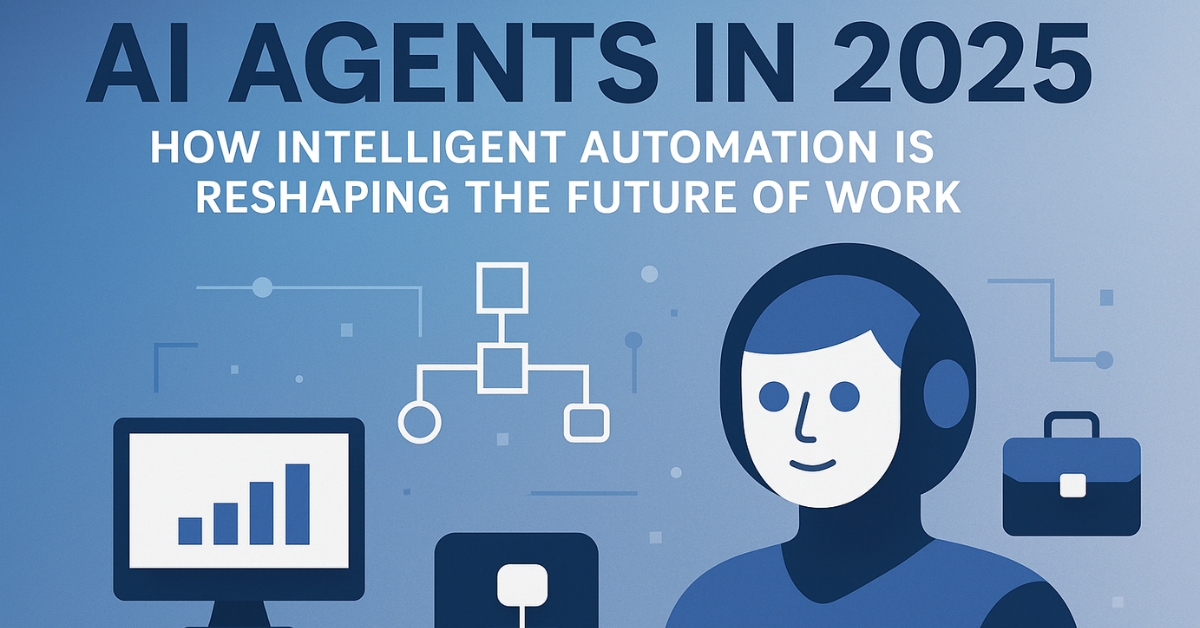
Discover how AI Agents in 2026 are transforming business, automating workflows, and redefining productivity. Learn the trends, tools, and strategies shaping the intelligent automation revolution.
AI Agents in 2026: How Intelligent Automation Is Reshaping the Future of Work
In 2026, the landscape of artificial intelligence is evolving faster than ever — and AI agents are at the heart of this revolution. From autonomous customer support systems to intelligent personal assistants that can execute entire workflows, AI agents in 2026 are redefining how businesses operate and how humans interact with technology.
What makes this year so special is the convergence of multiple breakthroughs: Generative AI, multi-agent collaboration, memory-augmented systems, and natural language autonomy. Together, these technologies are pushing the boundaries of what machines can do — not just respond, but reason, plan, and act.
This article dives deep into what AI agents are, how they work, their top use cases in 2026, and how they’re changing careers and industries worldwide.
Quick Facts: AI Agents 2026
| Metric | Insight (2026) |
|---|---|
| Global AI Agent Market Size | $38.7 Billion (Projected 2026) |
| Growth Rate | 34.2% CAGR (2023–2028) |
| Leading Platforms | OpenAI GPTs, Microsoft Copilot Studio, Google Vertex AI Agents |
| Common Uses | Automation, Data Analysis, Customer Support, Workflow Orchestration |
| Top Industries | IT, Marketing, Finance, Education, Healthcare |
What Are AI Agents?
An AI Agent is an intelligent system capable of perceiving its environment, making decisions, and performing actions to achieve specific goals — all with minimal human intervention. Unlike traditional chatbots or rule-based systems, modern AI agents are built using LLMs (Large Language Models) like GPT-5, combined with tools, APIs, and autonomous reasoning capabilities.
These agents can now operate across multiple platforms, retrieve data in real-time, integrate with SaaS tools, and even delegate tasks to other AI agents. In short, they’re becoming digital employees that can work 24/7 without fatigue.
The Evolution of AI Agents: 2020–2026
Between 2020 and 2026, AI agent technology has undergone an incredible transformation:
Phase 1 — Conversational AI (2020–2022)
Chatbots like early ChatGPT and Google Dialogflow dominated, offering scripted or semi-intelligent responses.
Phase 2 — Autonomous Tools (2023–2024)
With the rise of GPT-4 and Anthropic’s Claude, tools gained reasoning, coding, and planning abilities.
Phase 3 — Multi-Agent Collaboration (2026)
Now in 2026, AI agents can coordinate with each other — for instance, one agent handles research, another manages emails, and another executes automation tasks in the background. This has led to the concept of AI workforces.
Top Use Cases of AI Agents in 2026
1. Business Automation
Companies are using AI agents to automate complex workflows — from CRM updates to data entry and content creation. Agents can connect with Zapier, Notion, HubSpot, and Slack to carry out tasks automatically.
2. Customer Service
AI agents now resolve over 78% of customer queries without human escalation, drastically cutting costs and response times.
3. AI for Developers
Platforms like GitHub Copilot Agents and Replit AI empower developers with autonomous debugging, deployment, and documentation.
4. Education & Coaching
AI tutors and course assistants are transforming online education, offering personalized learning paths and real-time feedback.
5. Healthcare Assistants
AI agents assist doctors in analyzing reports, scheduling patients, and monitoring chronic conditions through wearable integrations.
How AI Agents Work: The Core Architecture
AI agents combine five critical components:
- Perception Layer – Gathers input (text, voice, or image)
- Reasoning Engine – Uses an LLM (like GPT-5) for understanding context
- Memory Module – Retains session or long-term knowledge
- Action Module – Executes real-world tasks via APIs or integrations
- Feedback Loop – Learns from outcomes to improve decisions
This multi-layer structure allows modern agents to operate autonomously and learn dynamically, improving their performance over time.
Why 2026 Is the Tipping Point for AI Agents
In 2026, three major forces are accelerating adoption:
- Maturity of Large Language Models (LLMs) – GPT-5, Gemini 2.0, and Claude 3.5 now have deeper reasoning.
- Open Agent Platforms – Tools like OpenAI GPTs, LangChain, and AutoGen make custom agent creation simple.
- Enterprise Demand – Businesses are actively replacing repetitive roles with intelligent digital counterparts.
According to TechCrunch, over 42% of Fortune 500 companies plan to deploy AI agents by mid-2026 — not just for cost savings, but to gain competitive agility.
Engagement Feature
Try This: Visit OpenAI’s GPT Builder and design a simple AI agent for your business idea. No coding required!
FAQs
1. What are AI agents used for in 2026?
They automate business workflows, assist in education, healthcare, and development, and serve as digital employees.
2. How do AI agents differ from chatbots?
Unlike rule-based chatbots, AI agents can reason, plan, and perform multi-step actions autonomously.
3. Can small businesses use AI agents?
Yes — tools like Zapier AI and OpenAI GPTs let small businesses automate processes affordably.
4. What skills will be in demand for AI agent developers?
Prompt engineering, Python, LangChain, API integration, and ethical AI design.
5. Are AI agents replacing human jobs?
They’re more likely to augment humans — taking over repetitive tasks so professionals can focus on creative and strategic work.
Useful Links
- OpenAI GPTs Documentation
- Google Vertex AI Agents
- LangChain for Developers
- How AI-Powered Chatbots Are Transforming Customer Service in 2026
- OpenAI GPTs Platform Overview
The era of AI Agents in 2026 represents a turning point in the relationship between humans and machines. These systems aren’t just assistants anymore — they’re partners in productivity. Businesses that understand and implement AI agents effectively will gain a decisive edge in automation, efficiency, and innovation.
If you’re a professional looking to future-proof your career, learning how AI agents work and how to build or manage them will be a vital skill set in the next decade.
Start exploring AI Agents today — the future of work is already here.
Author Block
Author: Ravi Kumar